Thursday, April 27, 2017

The Virtual Step

Virtual Reality enables the audience the ability to not only witness an artists work, but to visually engage into the work itself. Everything seen in the computer is (in a sense) is part of the virtual universe. The term is used for a three-denominational experience in which the user can 'step' into the virtual environment, with the use of specialized equipment such as body suits, eye covers, and gloves.

Since 1990, The Legible City made my Jeffery Shaw, allows an individual to explore a virtual world by simply riding a mounted bicycle. The viewer is expected to encounter buildings, signs, roadways, and more along the expedition. The work was said to predict what the future may hold for this line technology as progressing forward. People are said to become more familiar with the concepts of virtual reality, as much as they are now with modern television, telephones, computers, tablets, and other means of modern technology. We are already seeing this now with the introduction of virtual reality games that have recently been provided to the common public.

The Cave in 1992 was a virtual environment of stenographic computer graphics which interacts with the movements of the user equipped with stereo glasses, this allows for users to spot other users present in the same area. For every second, images are played out through the projection.

So.So.So. Somebody, Somewhere, Sometime by Maurice Benayoun enables users with VR binoculars to enter an environment of panoramic spheres that display images of people engaging in various activities at different times. Users create a new reality based on the pre-existing one when focusing on elements from different scenarios.

Artist Micah Ganske made his attempt at AVR with his project; Ocular EVA Pod - Augmented VR Project. In addition to the virtual reality provided through the Ocelus Rift, the created a six-foot tall sculptural cockpit which was 3D printed. The user is meant to feel as if he/she was piloting through a virtual environment created by Ganske. The user finds that the cockpit is replaced virtually in an enclosed glass EVA vehicle. The airlock doors open as the pod enters space and finds one of Ganske's alternate projects, an assemblage of spacecraft sculptures combined in the form of a humanoid figure. His work revolves around what he refers to as "Asperational Technology" which details what our future could have been and what he believes could still be.



Cinematic Installation

Contemporary artists have worked to produce participatory works of art, which goes beyond the simple premises of computer interactions. Viewers of the work become an essential part of the works's fiction.

Bill Seaman created an interactive triptych installation titled Passage Set/ One Pulls Pivots on the Tip of the Tongue  shows three projections that have highlighted text for present viewers to press, doing so will display a spatial poem that reflects the layering or collision of psychological spaces which allows for sequential reading, much like reading a poem or staring at a painting.

Paul Garrin's White Devil revolves around more social issues. When walking through a neighborhood, a dog suddenly chases after the viewer, seemingly so.

Ken Feingold's Childhood/Hot and Cold Wars (the Appearance of Nature), touching the clock will flood the viewer with images that represent 1950-1960's culture. The flow of the images can be controlled by the viewer.


Galápagos by Karl Sims shows off multiple abstract shapes in the form of 'genetic' organisms which viewers can grow their own. The work was inspired by Charles Darwin's famous theory on Natural Selection. 


Sims had also explored this concept through his other work, like Evolved Virtual Creatures, Evolution Simulation, 1994.


Saturday, April 22, 2017

Holography

The very idea of art made from holograms would often be thought of something found out of science fiction.  But as artists work on exploring and expanding on three denominational forms to this day, the idea has never been so far fetched as one might think (speaking for one's self).

Holography in general, is the science of producing holograms, illusions performed from a light field, rather than images projected through a lens. It requires the use of a laser in order to illuminate the subject matter of a given object.

The holographic method was first invented by Hungarian-British physicist Gábor Dénes, who received a  Nobel Prize in Physics in 1971 for his breakthrough.

Dieter Jung was a German artist known for working with holographic imagery. He developed a projected form of text which he titled BIBI BEI BOB, in 1987.


The National Polytechnic Museum of Sofia displays a self portrait, to whom it is unknown.

Holograms are more commonly found placed on credit/debit cards which are added as security features, they are applied so that they can not be removed as easily as they provide identity for the card's brand.

These images show two parts of a single hologram of a mouse as a means to reveal different angels of a projected object.


Work from the hard drive

Once the computer was made accessible by the common people, new forms of art work was introduced to the digital media. The calculative machines were used as a primary tool to create works that were in some ways futuristic by appearance.

Computer art, however, was not entirely met with positive feedback, as most works of computer art was left without credit (from well known artists) due to an anti-technology sentiment from counter-culturalists of the 1960s-1970s.

Lillian Schwartz's Pixillation was an image made entirely out of pixels, consisting of abstract imagery.

John Whitney's Catalog was a short film made by using outdated military computer equipment.

William Letham's The Evolution of Form is a series of complex images of three denominational objects which are "sculpted" by the computer.


Thursday, April 20, 2017

Generation of Computer Imagery

CGI (Computer Generated Imagery) has forever changed the way cinema has incorporated special effects. It's often rare to view a film of today's era without some influence in digital enhancements. Some people have feared that CGI may one day replace physical actors and environments all together, like in Rober Zemeckis's 2004 film, The Polar Express were every character was animated through motion capture.

The first ever CGI rendered character to at least express emotion as a believable entity, appeared on Young Sherlock Holmes in 1985 known as the Stained Glass Knight. Lucasfilm created the first "photorealistic" computer generated character, within 10 seconds of screen time.


Rise of Digital Filmography

"Cinema has become an art of video, rather than video art." Directors such as Steven Spielberg and Jean LucGodard are recognized as new-media digital artists. Around the time of the twentieth century, films have been heavily altered by digital special effects, such as the kind seen in Spielberg's classic: Jurassic Park in 1993. In the film, live actors would often be seen interacting with CGI models such as the Tyrannosaurus Rex in the films most famous scene.

New-age cimina is said to consist of illustrations that are multi-screen, multi-user, panoramic, dome-projected, and nonlocal. Isaac Julian explored these concepts through his works:

The Long Road to Mazatlán (1999)

 Paradise Omeros (2003)

Baltimore (2004)

These works were designed to embrace both the issues of racial and class identity, and the history/ theory of film including painting, choreography, and the psychology of memory. Each work is projected through multiple  screens in a filmed environment of cinematic sophistication.

Friday, April 14, 2017

Dawn of the Digital

The uprising of digital technology was unstoppable, and widely popular among artists with new and expansive opportunities. Once an image, language, ect was included into a computer, it could be altered in various ways.

Scanned work like the one from Lillian Schwartz Mona/Leo that shows a split image between Leonardo Da Vinci famous work; Mona Lisa, with a pic of a self portrait for the other half. 

Jean-Peirre Yvaral had also tweaked into Da Vinci's work by reconstructing the Mona Lisa into Synthesized Mona Lisa. 

Victor Burgin's Angelus Novus is a triptych of digital prints where the central piece shows a woman altered by the contrasts and exposure to lighting effects. From each side reveals bombs dropping from planes during World War II. Burgin intended for the viewers to see the 'angel' looking outward from the center of the piece, with her wings being flanked from each side. It is somewhat meant to only appear this way.

Thursday, April 13, 2017

Digital Dilemma

At its time, no other text grasps in developing a language addressing issues withing the art age of technology more than Walter Benjamin's The Work of Art in the Age of Mechanical Reproduction.

Benjamin's essay resolves around cultural criticism that proposes the devaluation of a work of art is consequent to its mechanical reproduction. Technology raised issues of authorship and the uniqueness of the art object whose 'aura; was lost in reproduction. It is debatable weather or not art still had retained its value once it's manufactured in a certain sense. Instantly, this reminds me of the "kitsch" term used by Clement Greenburg, who believed modern art at the time was tied more to mass production, and was not "genuine culture," as he would put it. Kitsch as how Greenburg had seen it, was art made simply for art's sake, and nothing else. A similar relationship can be seen on Benjamin's essay, discussing the issues with mass produced art.

Friday, April 7, 2017

Identities

Video artists have used their installations for deepening the examinations of the self. Video installations were designed to elaborate on the individuals who viewed the images themselves. The camera for instance was a tool created to conduct real-time images the self. Installations had the ability to do this with the addition of adding an alternately designed environment, thus executing an encompassing view. It also grants the viewers a sense of being included into the work itself, in a literal viewpoint.

Adrian Piper's What It's Like, What It Is #3 invites people into the work with screen projections of racial stereotypes that audinace members interact with as the projected individuals challenge their presumptions and prejudices. Out of the Corner consists of seventeen monitors and photographs, doing so involves the audinace in once again interacting with ethnic stereotypes whom address the audience with trivial questions.

Moving into theatrical performances once more, Lovers by Teiji Furuhashi has naked bodies perform aerobic activities while interacting with the audience. Voices murmur as bodies appear from the darkness as they confront the viewer, only to fall back into the void, with the shadow of AIDS hovering over the installation.


Monday, April 3, 2017

They Lyrical

Poetic ruminations were incorporated into installations by artists such as Steina Vasulka, who produced Orka in 1997. The installation reveals several strokes of birds passing by on screen, fallowed by a sequence of burning lava, and ocean waves. It expresses a motion that runs counter to the laws of physics as well for "frame-bound images," as described by Romaeuropa Webfactory. Stenia's work is set to describe the roots of her personal mindset. Orka was intellectually designed to homage her place of birth.


Bill Viola's work is praised for his work having the greatest tendency towards lyrical art. It comes form his interests in exploring the spiritual side of things along with explorations of light and form. In his work Installation, vertical slabs of granite turn as mirrored projections controlled via computer show three sets of human bodies submerged in water. Once again reminding me of a work done my an artist once mentioned from an earlier presentation.

The Stopping Mind was an installation made by Viola that incorporated sound into the images. The four screen installation was set to preoccupy the passing of time, where the seemingly peaceful images are interrupted by sudden violent sounds to give the illusion that the march of time has halted.

Sunday, April 2, 2017

The Political

Between the 1960s and 1970s, some artists had taken notice to arguments from art critics like Saint-Simon. Simon wanted to see artists apply political sensitivity into their work. Frank Gillette created his 1969 installation Wipe Cycle as a response to the critics urge. The installation is described to integrate the audience into the information, and enabled viewers to stand within the environment in order to make the viewers feel as if they are associated with information you would expect to see on headline news.
Irish Tapes in 1964 was a controversial installation by John Reilly and Stefan Moore designed to "bombard" the viewer with images of conflict in Northern Ireland. The installation includes several rare interviews with members of the Provisional IRA as well with individuals who suffered from unrelenting violence in Belfast (as mentioned via link).


Thursday, March 30, 2017

Installation

Installation art; a sculptor-based genre of artworks that are usually designed to alter the perception of space and are often site-specific. Because of it's close associations with sculptor, installation art received more acceptance from critics whenever allowed to be showcased within a museum, perhaps this was so seeing how the concepts of sculptor was so familiarized among art critics of that time. Installation art also exploited a sense of time and space, since instillation often required the use of video projections, it also associated what is called time-based media which involves video, sound, and linear/nonlinear time frames.

Nam June Paik explored this concept through Electronic Superhighway in 1995, and Video Jungle in 1977.

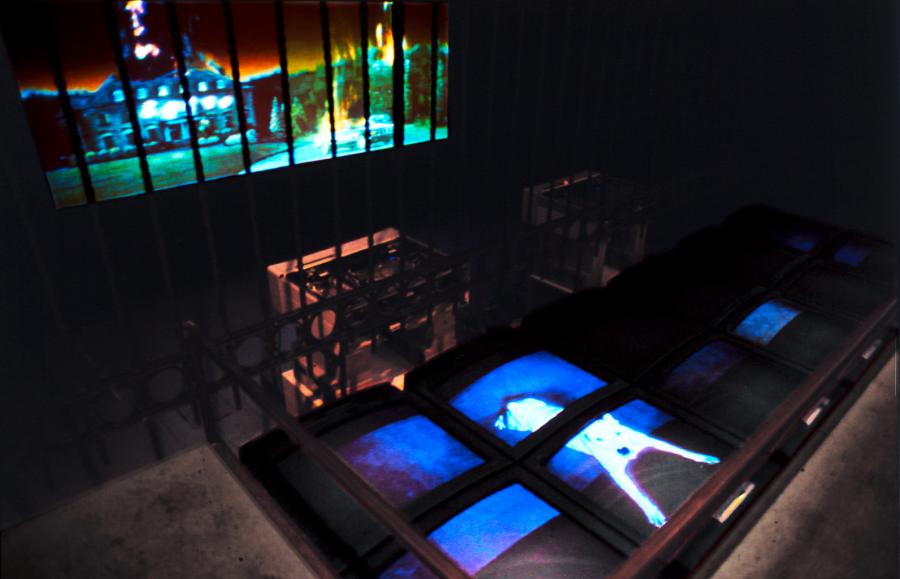
Shigeko Kubota was known for incorporating historical art references into her work, such as Duchampiania: Nude Descending a Staircase, 1976, which is an obvious nod to one of Marcel Duchamp's more popular works. The physical structure of the piece resembles that of a staircase with each with a monitor projecting a visual within.


Tuesday, March 28, 2017

Floating Parallels

As said in the last paragraph for Chapter 2; video art had developed into a profound medium for expressing innovative and experimental narratives. It has since then been viewed as a newly established genre within the art world, one of several mediums. 

Coming into Chapter 2's conclusion, one artist's work reminded of a presentation that was held in class several weeks ago. It was when it mentioned Anna Gaskell, an American photographer who is best known for her "ellipital narrative" series, including her 1997 project; Floater. 
Reading about the contexts about Floater reminded me on the work of another artist, whom worked on several feminist projects including a nude woman tied to the bottom of the water floating still as the wave currents moved steadily. It is to much regret that I can not remember the artists name nor the title of the work I refer to. Reading on this has had me thought about comparing the two works as well as their meaning. 


Personal Narratives

Bill Viola experimented with videotape electronics in his 1973 project; Information, where he used a self-interrupting error to perform a sequence of images he organized remotely, such as the images shown below.


Viola believed that video is a personal medium that helped explore expressive thoughts and philosophies. He explored mystical concepts which heavily influenced his work, such as I Do Not Know What It Is I Am Like in 1986.
 The video seeks into the connections to all living things, as well as a mystical journey into Visola's self-aware philosophy.

Sunday, March 26, 2017

Shock Value

Some artists such as Ana Mandieta and Chris Burdan express their work through more extreme techniques. For example, In Mandieta's work during graduate training in the Intermedia Department mainly consisted of performances of her distorted in shards of glass, or imprinting her body on sheets of paper while coated with animal blood. All of this was part of a collection of videotapes she titled Body Tracks in 1974. 

Mandieta's work resolved around the visceral connections with her body and nature, Chris Burdan made his work intentionally to startle viewers with their vivid imaginary. In his work: Through the Night Softly  in 1973, Burdan is seen crawling on a floor of broken glass with all his limbs tied together. In 1973, he had his friends witness him nearly being lit on fire in his project Icarus. 

It is said that Burdan's shocking and risky intentions express psychological insights into his relationship with the art world.

Friday, March 24, 2017

Manipulation of the moving image

While working into the television medium, artists had also attempted to experiment more into the technology of the camera itself, creating new works of expressive imaginary that in turn would be usurped by mainstream media and advertising. Artists such as Ed Emshwiller, Dan Sandin, and Kieth Sonnier would all take part in manipulating the camerawork in order to create exotic photographic works of art. Sonnier used an old Scanimate to make image collages including Painted Foot:Black Light (1970), Color Wipe (1973), and Animation II (1974). These abstract shapes and colors portrayed on the screen act as a metaphor to properties of physical paintings seen in classical forms of art.

The husband-wife team that was Stenia and Woody Vasulka worked on projects such as Home and Golden Voyage, 1973, both were made through manipulating the colorizing and electronic imaginary methods used withing video functions.

Other related works include:

Woody Vasulka Art of Memory, 1987
Objects, 1978
Transformations


Inspired by this, artist Nam Jun Paik preformed a similar technique in his work through a device named The Paik/Abe Synthesizer, which was designed for manipulating video image and colorization. This would eventually produce one of his works: Butterfly, in 1986.

Tuesday, March 21, 2017

A New Medium

"Artists were free to let their imaginations run rampant" as written by Lucy Lippard. Ever since Marcel Duchamp's Fountain  the idea of what truly makes art "Art" has since them been challenged and redefined. To this day we no longer see it exclusively in the form of classical mediums like paintings of well illustrated prostrates or gorgeous landscapes. In a way it has become a more emotional medium, revolving less on how something looks and how it makes the beholder feel, or feel reminded of which. This concept was heavily implied with the performance arts of which would be orchestrated on stage, but by around 1960, ninety percent of people could view these events at home with the availability of home entertainment through television sets. As new media was being introduced to a wider audience, Marshal McLuhan published his book: Medium is the Message: An Inventory of Effects, which was designed to help explain to new generation on how media impacts their way of living.


Famous artists from the postmodernism era produced several works in the form of video art, such as Andy Warhol who worked on the series Factory Diaries: Paul Johnson, 1965 and Chinese Dinner on Couch, 1965, including Outer and Inner Space in 1965.


Nam June Paik created video related projects not for any commercial purposes, but more on personal expression. which is evident on Zen for Head, 1962. It was to enact La Monte Young's performance score; Draw a straight line and fallow it.


Monday, March 20, 2017

Products of Postmodernism

The mid 20th century was the era where postmodernism took place, which was an era that unlike modernism, focused less on the consents of constructing fully original and innovative ideas, and instead works on expanding concepts that  have been used before, while also containing the attitudes of skepticism and irony. This, of course, would influence the ideologies of performer artists as well as their work. For example, The Wooster Group would reanimate classic theatrical texts while infusing them with new media, and imply the chaotic context of contemporary global culture into the mix as seen in one of their stage projects, Jump Cut in 1997.

F@usto: Verson 3.0 1998, was a performance piece orchestrated by La Fura dels Baus, an international performance group in Barcelona. The performance was designed to showcase disturbing imagery designed to help illustrate the tale of a formal agreement between man and the devil.

Performance of the Feminists

As video recorded performances became a widespread phenomenon for new media artists, feminists had also taken interest in expressing their philosophies into the visual media. One such project was a multimedia performance depicting a graphic tableaux titled To Have No Power Is To Have Power, made by German artist Ulrike Rosenbach in 1978.
The image here was designed for the intention to "attempt in making feminist traditions through resistance to hegemonic representations of women."

Orlan (originally named Mireille Suzanne Francette Porte) was a french multimedia performance artist who would often alter her body through recordings of her surgical operations, by doing so she has made numerous self portraits of her many different appearances including the samples from below.


The Obscure work of Bruce Nauman

Coming back to artist Bruce Nauman, who made his work without the intention for any interactions with an audience, but more to expand on personal qualities, and presenting "live sculptures" using his own body.

One of his works that was showcased in page 49 of Rush's New Media art, describes Anthro/Socio (Rinde Facing Camera).


One of Nauman's work caught my interest in researching, that being the preformance video: Clown Torture. It is said that Nauman often portrayed clowns in his work as it invoked his interest for erratic human behavior and language. The video provided below shows him in some screens moving  his limbs vigorously in random directions while yelling and pleading for help.