Thursday, April 27, 2017

Cinematic Installation

Contemporary artists have worked to produce participatory works of art, which goes beyond the simple premises of computer interactions. Viewers of the work become an essential part of the works's fiction.

Bill Seaman created an interactive triptych installation titled Passage Set/ One Pulls Pivots on the Tip of the Tongue  shows three projections that have highlighted text for present viewers to press, doing so will display a spatial poem that reflects the layering or collision of psychological spaces which allows for sequential reading, much like reading a poem or staring at a painting.

Paul Garrin's White Devil revolves around more social issues. When walking through a neighborhood, a dog suddenly chases after the viewer, seemingly so.
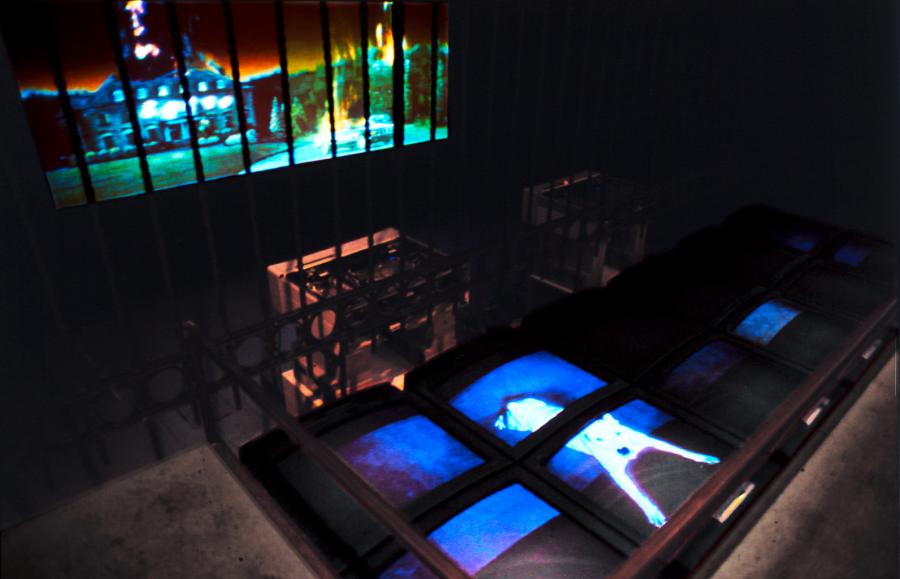
Ken Feingold's Childhood/Hot and Cold Wars (the Appearance of Nature), touching the clock will flood the viewer with images that represent 1950-1960's culture. The flow of the images can be controlled by the viewer.


Galápagos by Karl Sims shows off multiple abstract shapes in the form of 'genetic' organisms which viewers can grow their own. The work was inspired by Charles Darwin's famous theory on Natural Selection. 


Sims had also explored this concept through his other work, like Evolved Virtual Creatures, Evolution Simulation, 1994.


Saturday, April 22, 2017

Holography

The very idea of art made from holograms would often be thought of something found out of science fiction.  But as artists work on exploring and expanding on three denominational forms to this day, the idea has never been so far fetched as one might think (speaking for one's self).

Holography in general, is the science of producing holograms, illusions performed from a light field, rather than images projected through a lens. It requires the use of a laser in order to illuminate the subject matter of a given object.

The holographic method was first invented by Hungarian-British physicist Gábor Dénes, who received a  Nobel Prize in Physics in 1971 for his breakthrough.

Dieter Jung was a German artist known for working with holographic imagery. He developed a projected form of text which he titled BIBI BEI BOB, in 1987.


The National Polytechnic Museum of Sofia displays a self portrait, to whom it is unknown.

Holograms are more commonly found placed on credit/debit cards which are added as security features, they are applied so that they can not be removed as easily as they provide identity for the card's brand.

These images show two parts of a single hologram of a mouse as a means to reveal different angels of a projected object.


Work from the hard drive

Once the computer was made accessible by the common people, new forms of art work was introduced to the digital media. The calculative machines were used as a primary tool to create works that were in some ways futuristic by appearance.

Computer art, however, was not entirely met with positive feedback, as most works of computer art was left without credit (from well known artists) due to an anti-technology sentiment from counter-culturalists of the 1960s-1970s.

Lillian Schwartz's Pixillation was an image made entirely out of pixels, consisting of abstract imagery.

John Whitney's Catalog was a short film made by using outdated military computer equipment.

William Letham's The Evolution of Form is a series of complex images of three denominational objects which are "sculpted" by the computer.


Thursday, April 20, 2017

Generation of Computer Imagery

CGI (Computer Generated Imagery) has forever changed the way cinema has incorporated special effects. It's often rare to view a film of today's era without some influence in digital enhancements. Some people have feared that CGI may one day replace physical actors and environments all together, like in Rober Zemeckis's 2004 film, The Polar Express were every character was animated through motion capture.

The first ever CGI rendered character to at least express emotion as a believable entity, appeared on Young Sherlock Holmes in 1985 known as the Stained Glass Knight. Lucasfilm created the first "photorealistic" computer generated character, within 10 seconds of screen time.


Rise of Digital Filmography

"Cinema has become an art of video, rather than video art." Directors such as Steven Spielberg and Jean LucGodard are recognized as new-media digital artists. Around the time of the twentieth century, films have been heavily altered by digital special effects, such as the kind seen in Spielberg's classic: Jurassic Park in 1993. In the film, live actors would often be seen interacting with CGI models such as the Tyrannosaurus Rex in the films most famous scene.

New-age cimina is said to consist of illustrations that are multi-screen, multi-user, panoramic, dome-projected, and nonlocal. Isaac Julian explored these concepts through his works:

The Long Road to Mazatlán (1999)

 Paradise Omeros (2003)

Baltimore (2004)

These works were designed to embrace both the issues of racial and class identity, and the history/ theory of film including painting, choreography, and the psychology of memory. Each work is projected through multiple  screens in a filmed environment of cinematic sophistication.

Friday, April 14, 2017

Dawn of the Digital

The uprising of digital technology was unstoppable, and widely popular among artists with new and expansive opportunities. Once an image, language, ect was included into a computer, it could be altered in various ways.

Scanned work like the one from Lillian Schwartz Mona/Leo that shows a split image between Leonardo Da Vinci famous work; Mona Lisa, with a pic of a self portrait for the other half. 

Jean-Peirre Yvaral had also tweaked into Da Vinci's work by reconstructing the Mona Lisa into Synthesized Mona Lisa. 

Victor Burgin's Angelus Novus is a triptych of digital prints where the central piece shows a woman altered by the contrasts and exposure to lighting effects. From each side reveals bombs dropping from planes during World War II. Burgin intended for the viewers to see the 'angel' looking outward from the center of the piece, with her wings being flanked from each side. It is somewhat meant to only appear this way.

Thursday, April 13, 2017

Digital Dilemma

At its time, no other text grasps in developing a language addressing issues withing the art age of technology more than Walter Benjamin's The Work of Art in the Age of Mechanical Reproduction.

Benjamin's essay resolves around cultural criticism that proposes the devaluation of a work of art is consequent to its mechanical reproduction. Technology raised issues of authorship and the uniqueness of the art object whose 'aura; was lost in reproduction. It is debatable weather or not art still had retained its value once it's manufactured in a certain sense. Instantly, this reminds me of the "kitsch" term used by Clement Greenburg, who believed modern art at the time was tied more to mass production, and was not "genuine culture," as he would put it. Kitsch as how Greenburg had seen it, was art made simply for art's sake, and nothing else. A similar relationship can be seen on Benjamin's essay, discussing the issues with mass produced art.